

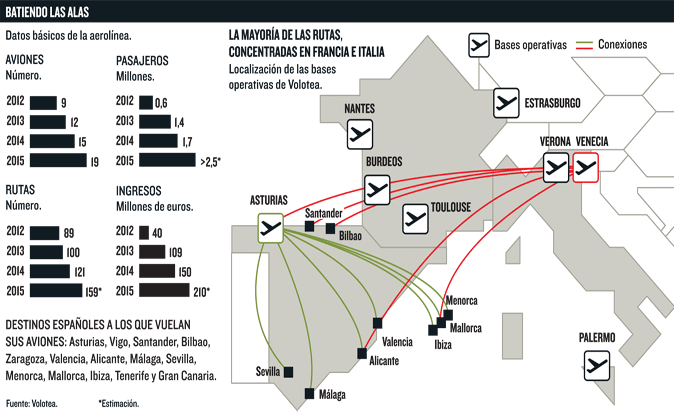
Source: Volotea
When the charismatic chairman of Planeta, José Manuel Lara, forced in 2007, as the main shareholder, the departure of Carlos Muñoz from Vueling due to disagreements in management, this entrepreneur did not want to leave the airline sector. His intention was to repeat the experience of building another business idea from scratch. The typical American attitude towards life, inherited from his time as a consultant at McKinsey & Company in San Francisco.
Volotea began its operations in April 2012 with part of the management talent it had at Vueling. Of course, together with his other key partner in the project, Lázaro Ros. The entire aesthetic and the way of addressing the customer has a tone that is very reminiscent of that genuine freshness of Vueling, only applied with a much smaller budget. However, it is not a clone, as their business models have little to do with each other. This new low-cost company does not aim to take market share from others, but rather to create it. “Its leitmotif is precisely to operate routes where either no one flies or only regional airlines of flag carriers do, such as Air Nostrum in the Spanish case, and at logically higher prices,” explains a transport expert from a major Spanish consultancy. For example, it connects Málaga with Bordeaux, Asturias with Venice and Mykonos with Munich. Volotea’s fleet consists of Boeing 717 aircraft, which have a capacity of 125 seats. These aircraft are neither as small as those flown by Air Nostrum nor as large as those of Ryanair or easyJet. compañías regionales de aerolíneas de bandera, como Air Nostrum en el caso español, y a unos precios lógicamente más caros», explica un experto en transporte de una gran consultora española. Por ejemplo, conecta Málaga con Burdeos, Asturias con Venecia y Mykonos con Munich. La flota de Volotea está compuesta por aviones Boeing 717, que tienen capacidad para 125 plazas. Estos aparatos no son ni tan pequeños como los que vuela Air Nostrum ni tan grandes como los de Ryanair o easyJet.
Volotea has its headquarters in Barcelona, because its intellectual founder and CEO resides there. However, none of its aircraft take off from the Catalan capital. Its only operational base in Spain is located in Asturias, a few kilometres from Avilés. Thanks to Volotea, Asturians can travel to eight small and medium-sized Spanish cities, and to Venice as an international destination. The company connects several mainland destinations with the Canary and Balearic Islands, such as Vigo, Santander and Zaragoza. However, Volotea’s Spanish activity does not reach even 5%. Almost all the business and the money-making engine is located in neighbouring France, where the penetration of low-cost airlines is lower, and in Italy. For example, it connects Prague with Bordeaux and Nantes with Montpellier. In total, it transports passengers to 71 European destinations.
Vueling began flying from Barcelona to the world and, until it started opening more bases, aircraft had to return to the capital. “In the case of Volotea, the route structure is not so radial, but rather has the shape of a mesh. In that sense it resembles Ryanair. This usually allows aircraft to fly more hours per year on average, one of the most important profitability metrics in the industry,” explains an airline consultant.
Volotea has developed a fairly advanced system for analysing the vast amount of data provided by IATA to minimise the margin of error when deciding to open a new route. Calculations are made based on information from passengers already travelling in that corridor, but with connections (therefore paying more expensive tickets due to double airport charges), and a multiplier factor is applied. Using different mathematical models, the company tries to estimate how many new travellers it could attract with a direct flight. The second part of the work consists of determining whether that potential demand would be sufficient to fill aircraft daily, three times a week or only during the summer season. One of the characteristics of current Volotea is precisely that it is quite seasonal. The bulk of its activity is concentrated too heavily in the summer months, when its workforce rises to around 600 employees.
The company of Carlos Muñoz operates only in secondary airports. From this point of view, it is a low-cost company in the strict sense. This also affects the salaries of pilots and crew. All ground services, the so-called handling, are outsourced. Ryanair also used to fly only to secondary airports, such as Girona. The difference is that it did not do so because it was interested in operating those destinations, but because flight rights were cheaper than those at El Prat in Barcelona. aeropuertos secundarios. Desde ese punto de vista se trata de una compañía low cost en sentido estricto. Esto afecta también a los sueldos de los pilotos y de la tripulación. Todos los servicios de tierra, el llamado handling, están externalizados. Ryanair también volaba antes solo a aeropuertos secundarios, como el de Gerona. La diferencia es que no lo hacía porque tuviera interés en operar esos destinos, sino porque los derechos de vuelo eran más baratos que los de El Prat de Barcelona.
Volotea’s cost base is quite light, even compared to other companies in its segment. Only 28% of costs are fixed. “Volotea is much more low cost than Vueling was at the beginning,” notes a former employee. As for revenues, this airline sells the typical packages of hotel rooms and car rentals, but it is not a true onboard supermarket, as in the case of the Irish Ryanair. The company obtains significant resources thanks to commercial agreements it reaches with airports to establish operations. It benefits from the negotiation margin that exists outside Spain, where in most cases the counterpart is not the regional administration, because the density of privately owned, or at least public-private, airports is much higher.
The type of traveller boarding its aircraft usually includes many Erasmus students and a good proportion of retirees who want to travel from southern England, France or Germany to the Balearic Islands or the Canary Islands. Only 15% of passengers take these flights for business, according to its figures. It carries more than 2.5 million passengers per year.
As a business creation, Volotea is inspired by the American airline Allegiant Air. However, there is no shareholding relationship like the one that existed between Vueling and JetBlue.
The start of its operations has coincided with a very favourable macroeconomic environment. The average price of Brent crude oil has been below $100 per barrel since the summer of 2014, an unusually favourable context. It is currently trading at historic lows of $30. According to investment bank strategic reports, oil will recover only moderately and will not exceed an average of $55–60 during 2016. According to market consensus, one or two years of calm are expected for the airline industry.
Fuel is the main headache for airline accounts and on average accounts for 40% of revenues. Each company mitigates this impact to a greater or lesser extent depending on the level of hedging it has contracted against price fluctuations. Most likely, the fact that fuel is cheap has been decisive in Volotea reaching technical profitability with only four years of operations. beneficiosThe company has not yet published its year-end results.
One could question how much fuel prices have influenced the company’s accounts, but not the viability of the business model, which so far has proven effective. The company already has 19 Boeing 717 aircraft, to which four Airbus A319 will be added this year, with the idea of gradually replacing this model. It is not common to have so many aircraft so quickly. “ Private equity funds [CCMP, Corpfin and Axis control 74% of Volotea’s capital] are usually very disciplined, and their participation in the project and allowing this growth pace is a sign of solidity,” notes a consultant.
During the unequal clash between José Manuel Lara and Carlos Muñoz at Vueling in 2007, the former accused the latter of being stubborn in refusing to open ticket sales to travel agencies. In the Volotea project, however, this sales channel has been incorporated from the beginning. It made perfect sense to do so, as the model allows and encourages it. A former collaborator of Carlos Muñoz states that he is not a highly personalist executive, or at least much less so than during the Vueling period, as Planeta often reproached him.
Its short history makes it inevitable that Volotea still shows a certain attention to detail. Its main weakness is the seasonality of the business, as its winter activity is limited. Its freedom of action is much greater than if it were integrated into a large aviation group, although at the same time this makes it more vulnerable, forces it to have its own loyalty programme and prevents it from benefiting from connecting passenger traffic.
The future lies in the incorporation of four new aircraft and in continuing to expand the route map. For now, no one has copied it. Volotea has set its sights on the stock market and will debut on the exchange within a few weeks, or months at most. Going public was the most likely option to finance the airline’s growth story. “It seems reasonable and even advisable. The current managers successfully led Vueling’s IPO in the past, and private equity thus finds an open route to recover part of its investment, or at least not have to inject more capital,” notes an airline consultant. The operation is coordinated by JPMorgan and Morgan Stanley. It will be a capital increase with a subsequent sale of shares restricted to professional investors, as reported to the CNMV.
Despite increased volatility, the Spanish stock market remains undervalued, and capital should continue flowing towards companies linked to the economic cycle and tourism, such as airlines. If Volotea wants to fly high, the stock market will not be what weighs down its wings.
Want to know more?
Corpfin Capital y Volotea – Expansion.com
View article